Steps in order –
- First it is important to know your schedule and how you can work in exercise around it. Some may more have frantic work/life schedules than others so this step is key. Below is a loose guideline of how many days a week you should work out.
- Minimum of 3 days for best results
- Maximum of 6 (may be pushing it for many)
- 3-5 days seems to be the sweet spot for most people to maximize results
- Minimum of 1 rest day a week, 2-3 is preferred.
- Next we need to choose a workout split. This just refers to the way we will break up the muscle groups to train throughout the week. Below are some good examples of popular splits people use.
- Push (shoulders, chest, triceps) , Pull (back and biceps), Legs (PPL) – works well if you plan to train 3 or 6 days a week
- upper , lower – works well if you plan to train an even number of days throughout the week – 2, 4 or 6 days
- Push, pull, legs, upper, lower – 5 day split
- Full body – works well for 3 days a week
- Assigning specific body parts together (ex: glutes & hammies) – works well with any # of days
- After we decide the workout split, we need to start structuring the workout. We can do that by using the following simple guidelines:
- Pick 2-3 exercises per large muscle group (quads, hammies, glutes)
- Pick 1-2 exercises per small muscle group (biceps, triceps, shoulders, etc)
- You only need to do between 4-8 exercises per workout depending on the split. If you can do more, you didn’t go hard enough.
- 4-6 is most optimal generally.
- Now that we have the general structure laid out, we need to plug in exercises to do based on the type of exercise.
- Start your workout with compound exercises (exercises that work multiple muscle groups at a time). Examples:
- Squats
- Lunges
- deadlifts
- Barbell rows
- Overhead press
- Pull ups
- Hip thrusts
- End with isolation exercises (exercises that work a single muscle group at a time). Examples:
- Bicep curls
- Tricep pushdowns
- Leg extensions
- Hamstring curls
- Calf raises
- After we have the exercises we are going to do on day of the training split laid out, we need to come up with how many sets and reps make sense for our goal.
- If the goal is endurance – 1-3 sets of 12-20 reps
- If the goal is hypertrophy (muscle growth) – 3-6 sets of 6-12 reps
- If the goal is maximal strength – 3-5 sets of 1-5 reps
- Then we need to decide how much rest makes sense to take between each set given our goal.
- For endurance – 0-90 seconds
- For hypertrophy – 1-3 minutes
- *if you’re doing less reps(6-8) heavier weight, closer to 2-3 min. If you’re doing more reps(10-12) less weight, closer to 1 minute rest*
- For maximal strength – 3-5 minutes
SIDE NOTE
It doesn’t matter if your goal is fat loss, muscle gain, etc. Your nutrition will take care of that aspect. For choosing your goal in terms of which method of rest you pick, think about if you want to have better endurance, build muscle/strength long term or specifically get stronger only.
7. Choosing the right weight
- Regardless of the rep range you’re training in, the last 3ish reps of your set should be very challenging. If they aren’t, increase weight. The goal is always to train close to muscular failure but not quite to it. Training until failure can be very taxing on the body.
- Use the double progression method to make progress faster.
- Before going up in weight, try adding 2 reps to each set
- For example: you’ve been doing 8 reps with 20 lbs, instead of just jumping to 25 lbs and doing 8 reps with that, start doing sets of 10 reps with the 20lbs. Once that becomes easy, then you jump up in weight and start back at 8 reps.
- This method ensures you are making progress in 2 different ways – by increasing both weight and reps over time.
- Once you have your routine put together, you will keep it the same week to week for 4-8 weeks before switching up exercises. At this point you can switch out only some of the exercises if you choose or all of them.
- During that 4-8 week period, make sure to include progressive overload. Examples of that include:
- More sets
- More reps
- More weight
- Less rest period
- Better muscle mind connection
- Better form
- As you progress, you can start adding in new techniques
- Drop sets -complete normal sets and reps for exercise then quickly reduce the weight by 20 to 25 percent and lift to failure, performing as many reps as you can
- Supersets – two exercises back to back with no rest in between
- Circuits – 3 or more exercises back to back with no rest in between
- Pyramid sets – increasing weight each set while reducing reps each set
- Reverse pyramid sets – decreasing weight each set while increasing reps each set
Pre strength training
Dynamic stretching (optional) & warm up sets (highly recommended). For the first exercise of each muscle group you are training on that day, I recommend doing a few warm up sets before jumping right into heavy weight. It depends on the exercise, but you can do anywhere from 30-50% of your working set weight to start and then build up to your top weight that you’ll be training at.
For example –
You plan to squat 200lbs for 8 reps today during your working sets. Working sets just refer to the top weight you plan to train for given your rep range for that session.
You can start by squatting 60-100lbs for your first warm up set, then add weight on in increments until you hit 200lbs. Usually 2-3 warm up sets is sufficient.
Post strength training
Static stretching & foam rolling (optional)
Cardio
Cardio is not essential for you to hit your goals but it can definitely help. Not to mention, your heart is a muscle so you shouldn’t neglect it. A solid 15-30 minutes of cardio 3-6 times a week after weight lifting or on rest days is a great tool to help aid fat loss. When we are aiming to build muscle though, it is best to keep the cardio on the shorter side as it will only increase the deficit you are trying to get rid of by eating in a surplus.
Deload weeks
Every 8-10 weeks you should have a deload week which is basically “taking it easier” for a week to let your body recover. It allows your body to come back stronger than before. Working out intensely places a large amount of stress on your body and as we know, stress can hinder our progress in the long term.
Side bar
Remember, you don’t NEED any 1 specific exercise. If you do not like an exercise, there are always alternative exercises you can do that will still help you achieve your goals.
For example, I absolutely HATE barbell squatting so I don’t program it in my routine but I enjoy alternatives such as the hack squat which I regularly will program into my routine. Both are great for building quads.
Additional guidance:
Tracking progress within workouts
It is best to use an app or track your workouts in the note section of your phone. This way, you have a record of what exercises you are doing, how many sets, reps and the weight over time. It is much easier to gauge your progress this way rather than just trying to remember it in your head.
Link to workout tracking journal:
More advanced app for tracking workouts
Emily Robinson Fitness –
For $4.99/month
Create and track your own workouts within my app. You can also track your meals and have access to a full calendar to plan out your workouts, take progress pictures & do weigh in’s.
Click here to get access to the app now.
Best beginners app for pre-built workout plans & overall guidance
Freshman Fitness –
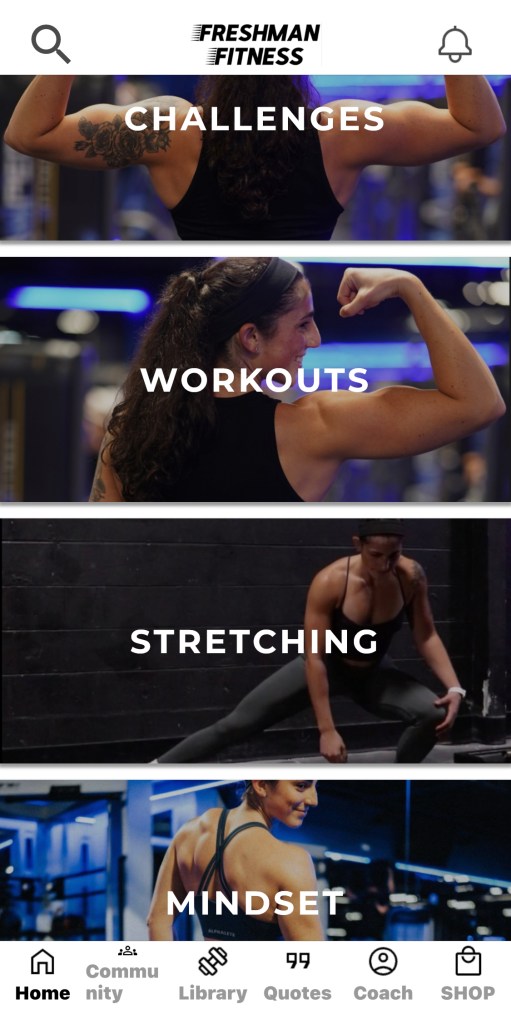
Click here on mobile to redirect to the app store
Full month workout routines, body part specific workout routines, an entire library of exercises broken out by muscle group, recipes, and a ton of learning content for beginners!
You can also apply for my 1:1 coaching by clicking here. Let’s work together 🙂
Click here to read about tracking progress with your body.
What shoes are best to wear?
Anything with a completely flat bottom will be best to increase stability at the foot therefore increasing the stability of all of your joints (knees, hips, etc) and improving performance overall. When we do compound lifts especially, we want to optimize at every level. Having a flat surface to push off from will help us significantly. Think about trying to squat on concrete vs. sand (not a perfect analogy but good enough)
- Nobull trainers – www.nobullproject.com
- Vans – https://amzn.to/3EGyPo9
- Converse – https://amzn.to/41wEJBT
- Nike blazers – https://amzn.to/3Zt3SeS
- Weightlifting shoes
When you wear running shoes or any type of shoe with cushion at the bottom, it significantly reduces the stability of your foot making it more difficult to balance and perform at your highest level. It will also be easier to injure yourself with this type of shoe during big lifts. It is totally ok to switch mid workout to this type of shoe (especially for isolation type lifts and cardio as it is much comfier usually).
Consider these items for weight lifting
Lifting straps – awesome for leg day lifts where you can lift more weight but the only limiting factor is your grip strength giving out
Weight lifting belt – used to increase lower back stability during heavy lifts and reduce chance of injury when used correctly. Highly recommend doing some research on breathing technique with a belt on
Chalk – helps reduce sweaty hands and enhance grip
Barbell pad – 100% necessary if you plan to barbell hip thrust unless you want to absolutely annihilate your pelvis. Realistically, it will probably still bruise some anyways but this will take most of the blow 😂 10/10 do not recommend using it for a barbell squat. Learn how to place the bar correctly and you’ll be fine 🙂
Affiliate codes –
First Health Apparel – firsthealthapparel.com – code EMILYR for 20% off
Legion Supplements – legionathletics.com – code ERFIT for 20% off
If you enjoyed this read –
This is a small portion of the eBook I recently created called “The Beginner’s Bible: A Simple Guide on How to Start Lifting Weights”. There are 10+ other documents in it just like this one. You can use this link to check it out: https://emilyrobinsonfitness.wordpress.com/thebeginnersbibletoweightlifting
Until next time,
Coach Emily
-
Stress & Sleep: The Missing Keys to Your Fitness Goals
If you’re training hard and eating well but still not seeing results, it’s time to take a look at two of the most underrated and overlooked factors in fat loss and muscle gain.. stress regulation and sleep quality. Your body doesn’t just need calories and workouts, it needs recovery, hormone balance, and nervous system support.…
-
Revamp Your Metabolism: A Beginner’s Guide to Boosting Energy and Burning Fat
Photo creds Your metabolism is like the engine that powers your body’s energy production and weight management. It’s responsible for converting the food you eat into energy, fueling your daily activities and bodily functions. However, factors like age, genetics, and lifestyle choices can impact your metabolic rate, leading to sluggishness and difficulty in managing weight.…
-
Avoid These 5 Mistakes When Tracking Calories
Tracking calories can be a powerful tool for managing your weight, improving your health, or achieving specific fitness goals. However, if done incorrectly, it can lead to frustration and less-than-optimal results. Here are five common mistakes to avoid when tracking calories to ensure you get the most out of your efforts. 1. Underestimating Portion Sizes…
-
How to Curb Cravings Without Getting Too Restrictive: Indulging in Moderation
Cravings are a common part of life, and while it’s important to maintain a healthy diet, it’s equally crucial not to get overly restrictive. After all, food is meant to be enjoyed. Finding a balance between curbing cravings and allowing yourself to indulge occasionally can be the key to long-term success in maintaining a healthy…
-
Sticking to Your Fitness and Nutrition Regimen While Traveling
Traveling can be an exciting and enriching experience, but it often throws a wrench in our usual fitness and nutrition routines. Whether you’re on a business trip or vacation, it’s possible to maintain your healthy habits with some planning and creativity. Below are some tips to help you stay on track with your fitness and…
-
A Beginners Guide to Building Strong and Sculpted Legs
Building strong, sculpted legs is a key goal for many gym goers, and for good reason. Strong legs improve overall athletic performance, enhance balance and stability, and play a vital role in daily activities. Plus, they look amazing! Duh. Whether you’re just starting your fitness journey or looking to refine your leg workout routine, this…


 The Freshman Fitness Blog by Emily Robinson
Leave a comment