As a newbie, you’re bound to make some mistakes in your fitness journey. We all do..
It is totally normal, but the faster you can correct those mistakes, the faster you can see results.
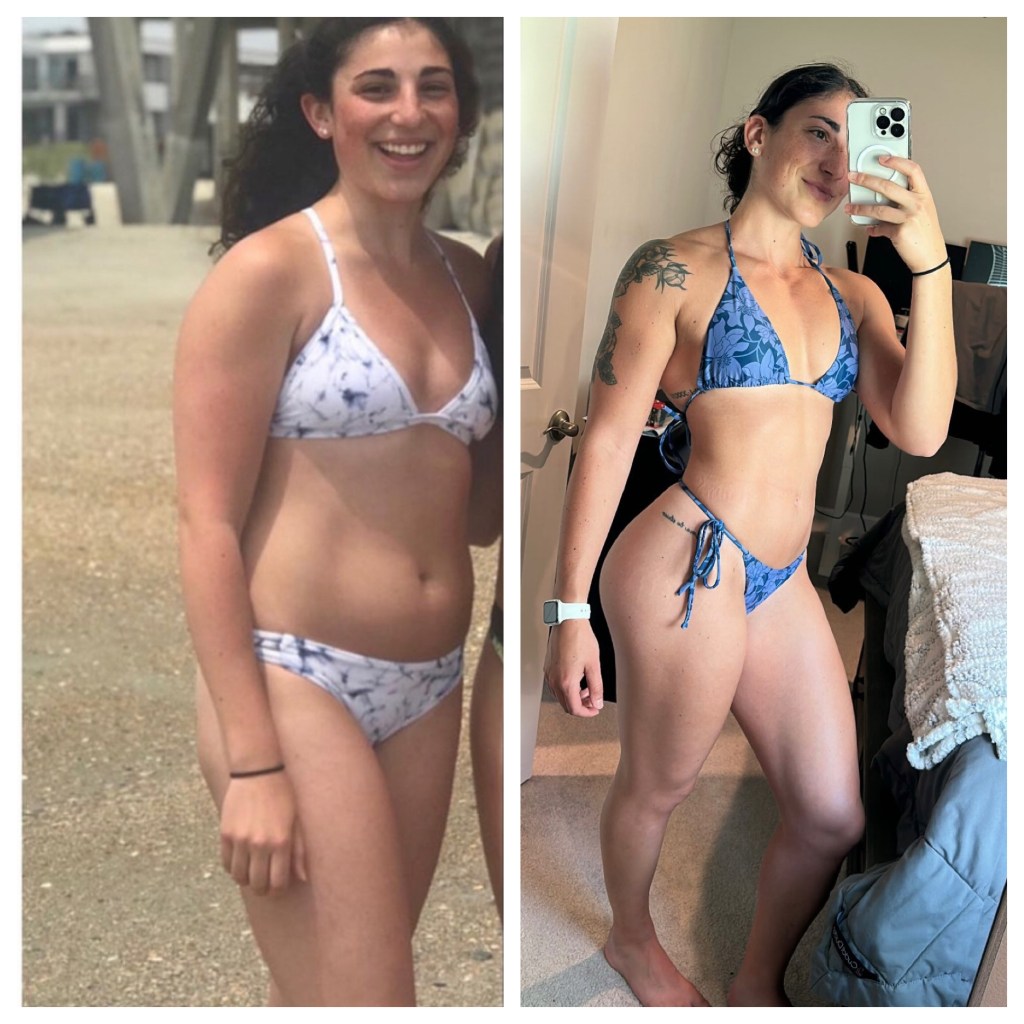
For reference, the time frame below from left to right was 5 whole years!
It took me a lot longer to see progress in my journey because I never got help, wanted to learn everything for myself, made a lot of mistakes, and did a lot of trial and error.
I don’t want it to take you as long as it took me to get good results so let’s avoid these mistakes below to hopefully speed up your journey!
Having no structured workout plan
I am always preaching this. Please do not just do random Instagram and Tik Tok workouts.
Sure they COULD potentially work for you, but generally they will not be geared towards your specific body and goals.
It is definitely better than doing a bunch of randomness but when you can, try to make your own workout plan that is geared towards what you want to accomplish.
Ideally, you want to keep the same routine week to week for 4-8 weeks at a time.
If you are unsure of how to do so, don’t worry. I got you covered.
Click here to read my post on how to make your own workouts.
Ignoring nutrition
This is a red flag. Nobody wants to be a red flag.
It is possible that you may be quote on quote “eating healthy” but that does not necessarily mean you are eating right for your goal.
In order to be eating right for your goal, you need to be focused on calorie or energy balance overall.
Fat loss = calorie deficit.
Maintain/body recomp = around maintenance level calories.
Muscle gain = calorie surplus.
If you just workout and don’t pay attention to your calorie intake you’ll likely never experience any true changes.
Heavy on the protein! A key to both building muscle and losing fat.
If you lack on your protein goal, you’ll likely be hungry and snacky throughout the day.
You’ll also lose muscle mass if you’re in a deficit and not eating enough protein.
You’ll struggle to gain any muscle mass but rather gain fat when eating in a surplus and not eating enough protein.
Did you know the body actually burns more calories when digesting protein than carbs or fats?
It actually helps slightly boost your metabolism through the thermic effect of food (TEF) which is part of the calculation of total daily energy expenditure (TDEE) or how many calories you burn every single day on average.
If you’re unsure of how to eat right for your goal, click here to read my post on how to calculate your calories and macros.
Doing cardio first
I used to do this A LOT and I did not realize it was completely killing my gains!
The only time you should do cardio before your lift is if your main goal is to build endurance, or if you are training for something specific like a race.
Otherwise, regardless of if your goal is fat loss, muscle gain, or body recomposition, you should do cardio after your lift.
The reason being that strength training has the most fat loss and muscle gain benefits so you want to save the most energy to put into that first.
Go hard lifting weights and THEN do your cardio.
You’ll experience more benefits during your cardio session as well as your heart rate will already be elevated from your lift, and you will be building up stamina doing cardio already pre exhausted.
When you do this in reverse though, you experience significantly less benefits as you will enter your strength training session fatigued because you already burned your fuel stores. You won’t be able to lift as much volume and with as much intensity as you would have. Less volume and intensity = less effective workout.
Ignoring time under tension
A lot of times I will see people absolutely BLOWING through reps as if they are lifting air.
This not only draws attention to you, but it’s simply not as effective as it would be if you were to SLOW IT TF DOWN.
Muscle is built when you are in the process of contracting your muscles. The longer you keep your muscle under that contraction, the more muscle building benefits you will have.
That is why one of the ways to progressively overload is actually just to slow down the tempo of your reps or use static holds.
Take your time going through reps.
Not tracking progress
A lot of people don’t track their calories, their exercises, reps, sets, weight, measurements OR progress pictures.
They simply just step on the scale and hope it is going in the direction they want it to.
But this is the WORST way to measure progress.
Yeah, it can potentially work in your favor but when you see no scale weight moving that is extremely demotivating and can make you want to give up completely.
I never took any progress pictures at the beginning of my journey and I 100% regret it.
The simple facts are that if you don’t know where you started, you’re going to have a hard time gauging progress or physically seeing it.
You want to celebrate all your small wins even if it is simply doing 1 more rep than you did last week.
This is the best way to ensure you are progressively overloading.
This will lead up to your big wins such as losing inches on your waist, seeing scale weight move, building your shoulders, etc!
Conclusion
Next time you’re in the gym, make sure to pull up this post as a reminder of what NOT to do!
And if you’re not confident you can achieve your goal on your own, I’m here for ya!
I have 2 spots currently open in my 1:1 online training program. Click here to apply.
Until next time,
Coach Emily
Check out some of my other posts below:
-
Breathe Your Way to Better Workouts: How Your Nervous System Shapes Fitness
Photo cred Most people think hitting fitness goals comes down to reps, sets, and macros. But here’s the thing… your body doesn’t just run on protein shakes and willpower. It runs on states. The state of your nervous system dictates a lot about your performance and recovery. And the sneaky but powerful lever you have…
-
Stress & Sleep: The Missing Keys to Your Fitness Goals
If you’re training hard and eating well but still not seeing results, it’s time to take a look at two of the most underrated and overlooked factors in fat loss and muscle gain.. stress regulation and sleep quality. Your body doesn’t just need calories and workouts, it needs recovery, hormone balance, and nervous system support.…
-
Revamp Your Metabolism: A Beginner’s Guide to Boosting Energy and Burning Fat
Photo creds Your metabolism is like the engine that powers your body’s energy production and weight management. It’s responsible for converting the food you eat into energy, fueling your daily activities and bodily functions. However, factors like age, genetics, and lifestyle choices can impact your metabolic rate, leading to sluggishness and difficulty in managing weight.…
-
Avoid These 5 Mistakes When Tracking Calories
Tracking calories can be a powerful tool for managing your weight, improving your health, or achieving specific fitness goals. However, if done incorrectly, it can lead to frustration and less-than-optimal results. Here are five common mistakes to avoid when tracking calories to ensure you get the most out of your efforts. 1. Underestimating Portion Sizes…
-
How to Curb Cravings Without Getting Too Restrictive: Indulging in Moderation
Cravings are a common part of life, and while it’s important to maintain a healthy diet, it’s equally crucial not to get overly restrictive. After all, food is meant to be enjoyed. Finding a balance between curbing cravings and allowing yourself to indulge occasionally can be the key to long-term success in maintaining a healthy…
-
Sticking to Your Fitness and Nutrition Regimen While Traveling
Traveling can be an exciting and enriching experience, but it often throws a wrench in our usual fitness and nutrition routines. Whether you’re on a business trip or vacation, it’s possible to maintain your healthy habits with some planning and creativity. Below are some tips to help you stay on track with your fitness and…
 The Freshman Fitness Blog by Emily Robinson
Leave a comment