The best way to stay consistent in the gym is to create a schedule that is realistic for your personal life so that you can reasonably stick to it week to week without draining yourself.
Since everyone’s personal life varies quite a lot due to differences in family life, social life and profession, this means there’s never going to be a “1 fits all” gym schedule that will work for you.
This is also a big reason I don’t like when people just follow random routines/schedules that influencers or coaches post on Instagram or other social media AND a big reason why I never post my own.
It’s a great way to set yourself up for failure right off the bat.
Being a coach, obviously I’d recommend 1:1 for everyone who can afford it since its custom to you and your life/schedule.
This sets you up automatically to achieve the best results possible.
And if you think I’m lying, let me insert some proof of clients who have worked with me in the past:
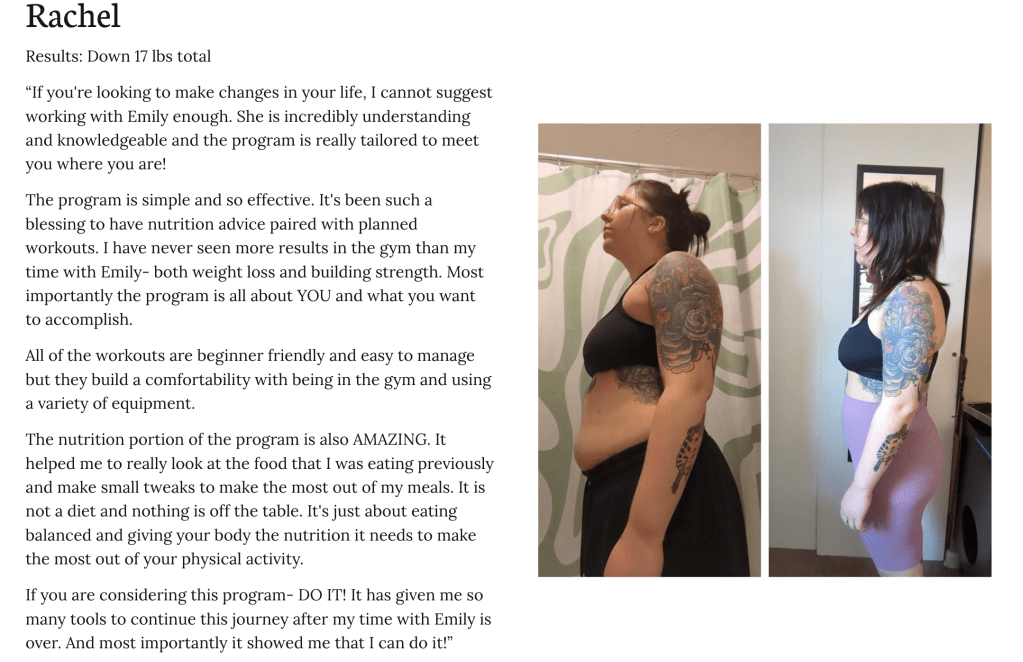
3 month transformation.

4 month transformation.
This is just two of many. You can check out others here.
I don’t want to bore you with the intricate details, but essentially, it works and I’ll detail out for you below the steps that you can take to work this out for yourself (if you don’t feel like hiring me…sad face).
Step 1: Determine realistically how many days you can workout weekly
A minimum recommendation would be 3 days, and a max would be 6 days.
If your schedule is completely hectic, it makes sense to shoot for 3 days.
If your schedule is moderately packed, 4-5 days makes sense.
If your schedule is pretty lax, 5-6 days should be easily doable for you.
1 rest day a week is completely necessary, but 2-3 is preferred.
Step 2: Determine what split makes sense for how many days you’re able to go to the gym
For a 3 day split, full body is usually good or PPL (push, pull, legs).
For a 4 day split, full body or LPPL (legs, push, pull legs).
For a 5 day split, PPL U/L is my go to (push, pull, legs, upper, lower).
For a 6 day split, PPL PPL is good (push, pull legs 2x).
These are just general recommendations. However you choose to break up your split is perfectly fine as long as you’re hitting every body part at least once a week (but preferably twice is best if you can).
Step 3: Determine how long your sessions can/need to be
Generally speaking, I’d say a solid weight lifting session lasts about an hour. Now, that’s not to say it can be a bit shorter or longer, but you definitely don’t need to be in the gym 2-3 hours a day.
You can absolutely get an effective workout session in if you’re doing super sets and circuits in about 30 minutes.
I’d argue if you’re training for more than an hour and a half ish, you’re probably doing too much unless you’re just taking realllllly long breaks (like 5 minutes) between your sets to recover strength which would be more of a powerlifting thing or if your goal is just straight strength and nothing else.
Step 4: Determine what time makes most sense for you to be able to consistently show up
Maybe you’ll be most consistent if you schedule out time to hit the gym before work and get it done.
Maybe you’ll be more consistent if you schedule out time during your lunch break to hit the gym.
Maybe you’ll be the most consistent if you schedule a time after work to hit the gym.
Maybe you’ll be most consistent if you lift on weekends or off days.
This will obviously differ for every person.
It depends on a variety of things such as your work schedule, what times you have the most energy during the day, and your family/at home schedule.
Step 5: Leave room for flexibility but make sure you’re still able to stay consistent with your new plan
It never hurts to have a back up plan for when things go wrong (and they will).
I would have 2 times that work for your schedule ready to go in case the first one doesn’t work out or you need a last minute switch due to a change of plans in your schedule.
This may even mean that you need to shift your workout to a completely different day, but it almost never means that you just skip that workout because “you couldn’t make it” unless of course there is a serious emergency or something of higher importance that you need to attend to.
But no, just because you had to work longer than normal is not considered a good excuse to skip your workout.
Step 6: Hire a trainer if you need to
This step isn’t 100% necessary of course, but it certainly can help you stick to steps 1-5 or just make them a lot easier for you in general.
For example, as your trainer I tell you the following –
- How many days a week you’re going to work out
- What split you’ll do
- What exercises you’ll do
- How many sets and reps you’ll do
- How long it should take you to do it
- What days you will workout
Flexibility to shift your schedule as needed is also included. You just need to show up at a time of day that works for you and figure out what weight to lift based on the workout instructions. Pretty simple.
Much easier to get it done when you have less to think about.
And then if you fail to do it, I will yell at you (nicely of course).
So the accountability aspect is there as well. It’s easier to get things done when other people are relying on you, or just annoying you a great deal and you want them to go away.
If you’re someone who needs to be yelled at, I got you!
Some of us do, it’s okay. Nothing to be ashamed of.
You can click here to apply to be yelled at by me 1:1.
Until next time,
Coach Emily
-
Stress & Sleep: The Missing Keys to Your Fitness Goals
If you’re training hard and eating well but still not seeing results, it’s time to take a look at two of the most underrated and overlooked factors in fat loss and muscle gain.. stress regulation and sleep quality. Your body doesn’t just need calories and workouts, it needs recovery, hormone balance, and nervous system support.…
-
Revamp Your Metabolism: A Beginner’s Guide to Boosting Energy and Burning Fat
Photo creds Your metabolism is like the engine that powers your body’s energy production and weight management. It’s responsible for converting the food you eat into energy, fueling your daily activities and bodily functions. However, factors like age, genetics, and lifestyle choices can impact your metabolic rate, leading to sluggishness and difficulty in managing weight.…
-
Avoid These 5 Mistakes When Tracking Calories
Tracking calories can be a powerful tool for managing your weight, improving your health, or achieving specific fitness goals. However, if done incorrectly, it can lead to frustration and less-than-optimal results. Here are five common mistakes to avoid when tracking calories to ensure you get the most out of your efforts. 1. Underestimating Portion Sizes…
-
How to Curb Cravings Without Getting Too Restrictive: Indulging in Moderation
Cravings are a common part of life, and while it’s important to maintain a healthy diet, it’s equally crucial not to get overly restrictive. After all, food is meant to be enjoyed. Finding a balance between curbing cravings and allowing yourself to indulge occasionally can be the key to long-term success in maintaining a healthy…
-
Sticking to Your Fitness and Nutrition Regimen While Traveling
Traveling can be an exciting and enriching experience, but it often throws a wrench in our usual fitness and nutrition routines. Whether you’re on a business trip or vacation, it’s possible to maintain your healthy habits with some planning and creativity. Below are some tips to help you stay on track with your fitness and…
-
A Beginners Guide to Building Strong and Sculpted Legs
Building strong, sculpted legs is a key goal for many gym goers, and for good reason. Strong legs improve overall athletic performance, enhance balance and stability, and play a vital role in daily activities. Plus, they look amazing! Duh. Whether you’re just starting your fitness journey or looking to refine your leg workout routine, this…
 The Freshman Fitness Blog by Emily Robinson
Leave a comment